
I was expecting to find that wind strengths in the Blue Mountains have been increasing over time, due to the increasing intensity of storms. Wind storms cause extensive damage to structures, cut power, block roads and even occasionally kill people in the Blue Mountains. However, there is good news – it turns out that this is not the case. This is possibly due to a phenomenon called “Terrestrial Stilling”. Here’s a comparison of monthly average wind strengths this century (red) and last century (green), from the BOM Climate Data page. 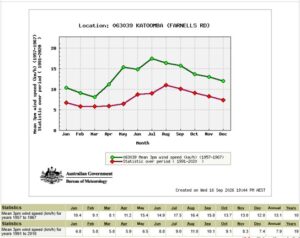
I asked Google this question and it came up with a really interesting answer (with references to the BOM, CSIRO, and 10 scientific papers):
“Comparing average wind strengths in Katoomba in the 20th century with now are wind strengths decreasing?”
Google said:
Yes, broad long-term scientific data indicates that average surface wind strengths in Katoomba have generally decreased compared to much of the 20th century, though there has been a complex stabilizing or slight recovery trend over the last decade. [1]
The “Terrestrial Stilling” Phenomenon
Between the 1970s and the 2010s, scientists identified a widespread global trend known as terrestrial stilling—a measurable slowdown of near-surface wind speeds across landmasses. [1]
Research spearheaded by Australian institutions like the CSIRO and the Australian National University analyzed comprehensive anemometer network grids across the continent: [1, 2]
Widespread Declines: Near-surface wind speeds decreased over 88% of the Australian land surface from 1975 through 2006.
Elevation Impact: Studies revealed that surface wind speeds declined more rapidly in high-elevation regions. As a peak town in the Blue Mountains situated at an elevation of 1,017 meters, Katoomba sits directly within the geographical profile most affected by this high-altitude “stilling”. [1, 2, 3, 4]
Primary Drivers of Changing Wind Strengths
Climate scientists attribute these shifting wind profiles to a combination of localized and large-scale atmospheric factors:
Increased Surface Roughness: As areas surrounding weather stations undergo urbanization, land-use shifts, and changes in regional vegetation or forest canopy cover, the ground surface becomes “rougher”. This physically drags against the air and slows down the winds closest to the ground.
Shifting Weather Systems: According to the Bureau of Meteorology and the CSIRO, climate change has expanded the subtropical high-pressure ridge southward over southern Australia. This expansion means more stable high-pressure systems dominate the region, which frequently bring lighter, calmer winds and fewer of the strong frontal systems that historically swept through the Blue Mountains. [1, 2, 3]
The Modern Turning Point
While the contrast between the mid-to-late 20th century and the early 2000s shows a clear decline, global and domestic climate data updated into the 2020s shows that the stilling trend broke or partially reversed around 2010–2013. Driven by cyclical multi-decadal ocean-atmospheric oscillations, average wind speeds have experienced a minor strengthening phase or “recovery”. [1, 2, 3, 4]
Today, Katoomba’s long-term historical baseline sits at a relatively gentle annual mean wind speed of 9.4 km/h at 9 am and 9.9 km/h at 3 pm. While day-to-day weather still features high-velocity wind events and severe gusts—particularly during winter and spring when westerly synoptic systems peak—the multi-decade baseline average remains lower than its 20th-century peak. [1, 2, 3]